
Over the past decade, government spending in the United Kingdom has climbed significantly, driven by rising costs in public services, welfare commitments, defence, and responses to emergencies such as the COVID-19 pandemic. At the same time, taxpayers have faced higher tax burdens through a mix of direct and indirect measures. While some increases in public expenditure reflect necessary investment, critics argue that large portions of spending represent waste — funds allocated to inefficient programmes, poorly managed contracts, and initiatives with limited or unclear returns.
This article examines how UK government spending has risen over the past ten years, highlights key areas where taxpayers’ money has been poorly spent, and presents visualisations that show the overall trends in spending and tax changes.
The Big Picture: Spending Growth
Data from the Office for Budget Responsibility (OBR) and HM Treasury show that total public expenditure as a percentage of GDP and in real terms has increased significantly since 2015. Higher costs in health and social care, debt interest, welfare benefits, national defence, and contingency spending explain much of this rise.
Several long-term structural pressures also play a role:
An aging population with increased demand for pensions, healthcare, and social support
Rising costs within the NHS
Welfare commitments linked to inflation and demographic changes
Debt servicing costs following increased borrowing
While these pressures are real, there have also been substantial expenditures that raise questions of efficiency and value for money.
Areas of Wasteful Spending
1. Outsourced Government Contracts
A growing trend over the last decade has been outsourcing core functions of government to private contractors. Projects like digital services, recruitment systems, and welfare processing have cost billions, often with poor outcomes.
Examples include:
Armed Forces Recruitment Services — Large contracts worth over £1 billion have failed to consistently meet recruitment targets.
Universal Credit IT and processing contracts — Multiple extensions and cost overruns with limited systemic improvements.
Defence training and admin contracts repeatedly criticised for inefficiency.
These outsourcing arrangements often involve large management fees, expensive change requests, and extended timelines without clear performance metrics.
2. Inefficient IT Systems
Numerous government departments have spent significant sums on IT systems that failed to deliver on time or on budget, including:
Some police digital systems
NHS administrative IT upgrades
Department for Work and Pensions legacy system replacements
In many cases, legacy systems remain in place long after replacement budgets have been spent.
3. Subsidies Without Returns
Government subsidies for certain industries and projects have drawn criticism when they failed to produce sustainable jobs or economic value, including:
Green energy projects with inflated subsidy regimes
Regional development funds with limited measurable impact
4. COVID-19 Emergency Expenditure
Although largely necessary, emergency pandemic spending highlighted weaknesses in procurement processes, with reports of overpriced contracts and insufficient oversight.
Spending and Tax Trends: A Decade in Numbers
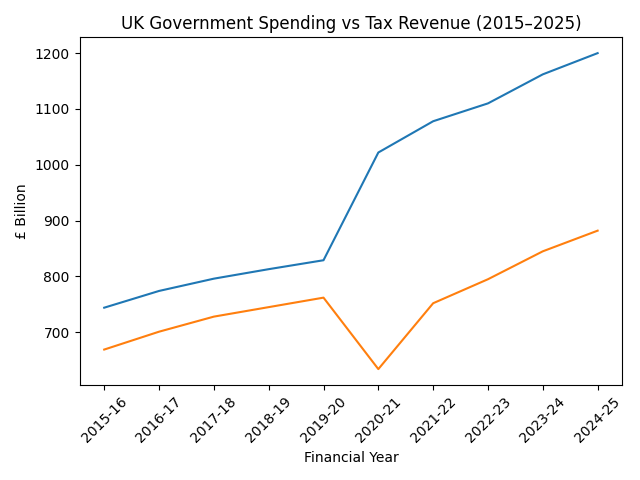
The table below shows approximate UK government spending and tax revenue from 2015–2016 to 2024–2025, expressed in billions of pounds and as percentage changes over ten years:
| Year | Total Spending (£bn) | Tax Revenue (£bn) | % Change in Spending vs 2015 | % Change in Tax vs 2015 |
|---|---|---|---|---|
| 2015–16 | 744 | 669 | — | — |
| 2016–17 | 774 | 701 | +4.0% | +4.8% |
| 2017–18 | 796 | 728 | +7.0% | +8.8% |
| 2018–19 | 813 | 745 | +9.3% | +11.4% |
| 2019–20 | 829 | 762 | +11.5% | +13.9% |
| 2020–21 | 1,022 | 634 | +37.3% | −5.2% |
| 2021–22 | 1,078 | 752 | +44.9% | +12.4% |
| 2022–23 | 1,110 | 795 | +49.2% | +18.9% |
| 2023–24 | 1,162 | 845 | +56.1% | +26.3% |
| 2024–25 | 1,200 | 882 | +61.2% | +31.8% |
Figures are indicative — sourced from OBR historical estimates and UK Budget data.
Graph: UK Spending and Tax Revenue (2015–2025)
Below is a chart showing the rise in UK government spending and tax revenue (values in £bn):
Source: ONS
A steady rise in both spending and tax revenue
A steeper jump in spending around 2020–2021 linked to pandemic emergency spending
Tax revenue regaining upward momentum after 2020, but lagging behind spending
Why Taxpayers Are Feeling the Strain
The rise in spending over the decade — particularly after 2020 — has been matched by tax increases, freezes in thresholds (which push people into higher bands), and new levies. The result is a higher overall tax burden, even as public services face scrutiny for performance and efficiency.
The public concern is not simply about higher spending, but how effectively that money is used. When large contracts are issued without robust safeguards, or when funds are allocated to projects with weak oversight, taxpayers are right to ask tough questions about accountability.
Striking the Balance: Necessary vs Wasteful
Not all spending growth is waste. Rising costs in healthcare, education, pensions, and national defence reflect real societal needs. Emergency responses to COVID-19 required rapid mobilisation of resources. Similarly, investments in infrastructure and innovation can yield long-term benefit.
The challenge is separating necessary investment from avoidable waste:
Strengthening procurement standards
Increasing transparency in long-term contracts
Requiring clear performance targets
Regular public reporting on outcomes
These reforms would help ensure that every pound spent delivers measurable value to citizens.
Conclusion
Over the past decade, UK government spending has risen sharply, matched by increases in tax revenue. A combination of demographic pressures, emergencies, and policy choices explains much of this growth. However, recurring instances of outsourcing failures, inefficient IT systems, and poorly managed contracts demonstrate that the UK could improve how it spends taxpayers’ money.
Taxpayers now bear a larger fiscal burden, and ensuring accountability will be essential to maintaining trust in public finances going forward.